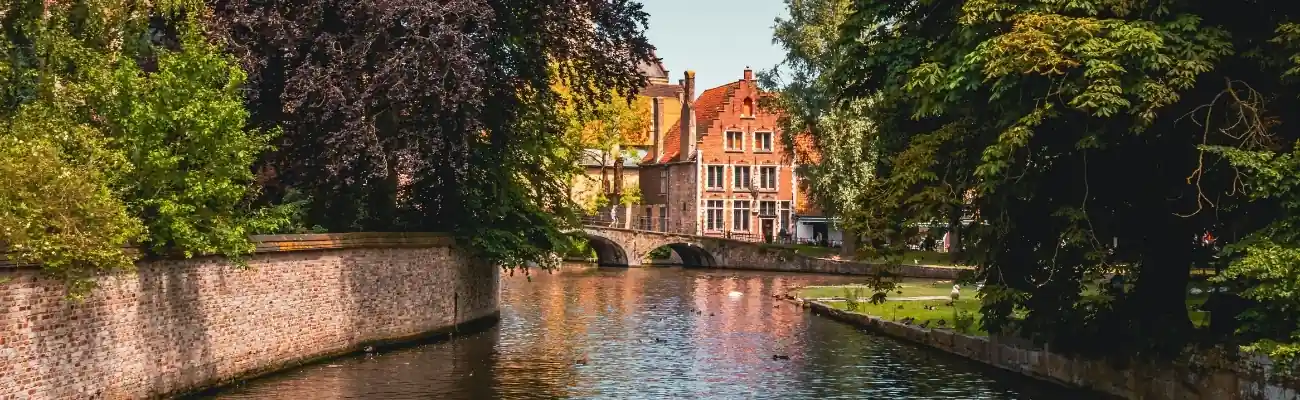
The question arises reliably in travel planning conversations about Belgium: Is one day in Bruges enough, or should you stay the night? It is a reasonable thing to wonder. Bruges is small. The historic centre can be walked end to end in twenty minutes. The train from Brussels takes an hour and runs frequently in both directions. The case for a day trip is straightforward to make.
And yet the question persists, and the reason it persists is that experienced visitors who have done both consistently say the same thing: the overnight stay and the day trip are not the same experience. They are not even close to the same experience. The city that exists between the hours of 7 pm and 9 am the following morning, quieter, softer, lit differently, populated by residents rather than tour groups, is the version of Bruges that most day-trippers never see, and it is the version that generates the kind of travel memories people mention years later.
This guide gives you an honest account of both options: what a day trip delivers, what it misses, what an overnight stay adds, and a clear framework for deciding which choice is right for your specific trip.
What You Can Realistically Do in a Day Trip to Bruges
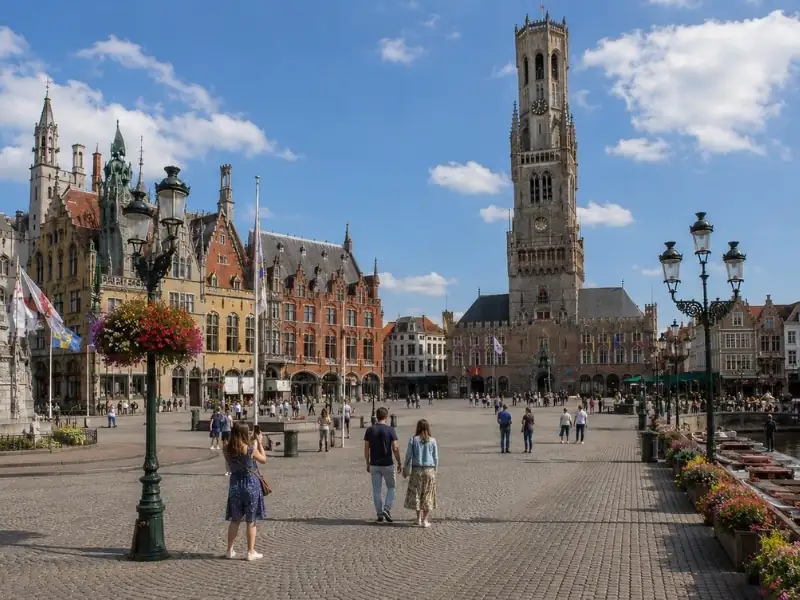
A day trip from Brussels gives you approximately six to seven hours in Bruges, enough to see the headline attractions, eat well, and form a strong impression of the city. A day trip from Amsterdam or London gives you considerably less usable time once travel is factored in. The honest assessment of what a good day trip delivers:
What a day trip covers comfortably
- The Markt and Burg Square - the two central squares, including the exterior of the Belfry, the Basilica of the Holy Blood, and the City Hall
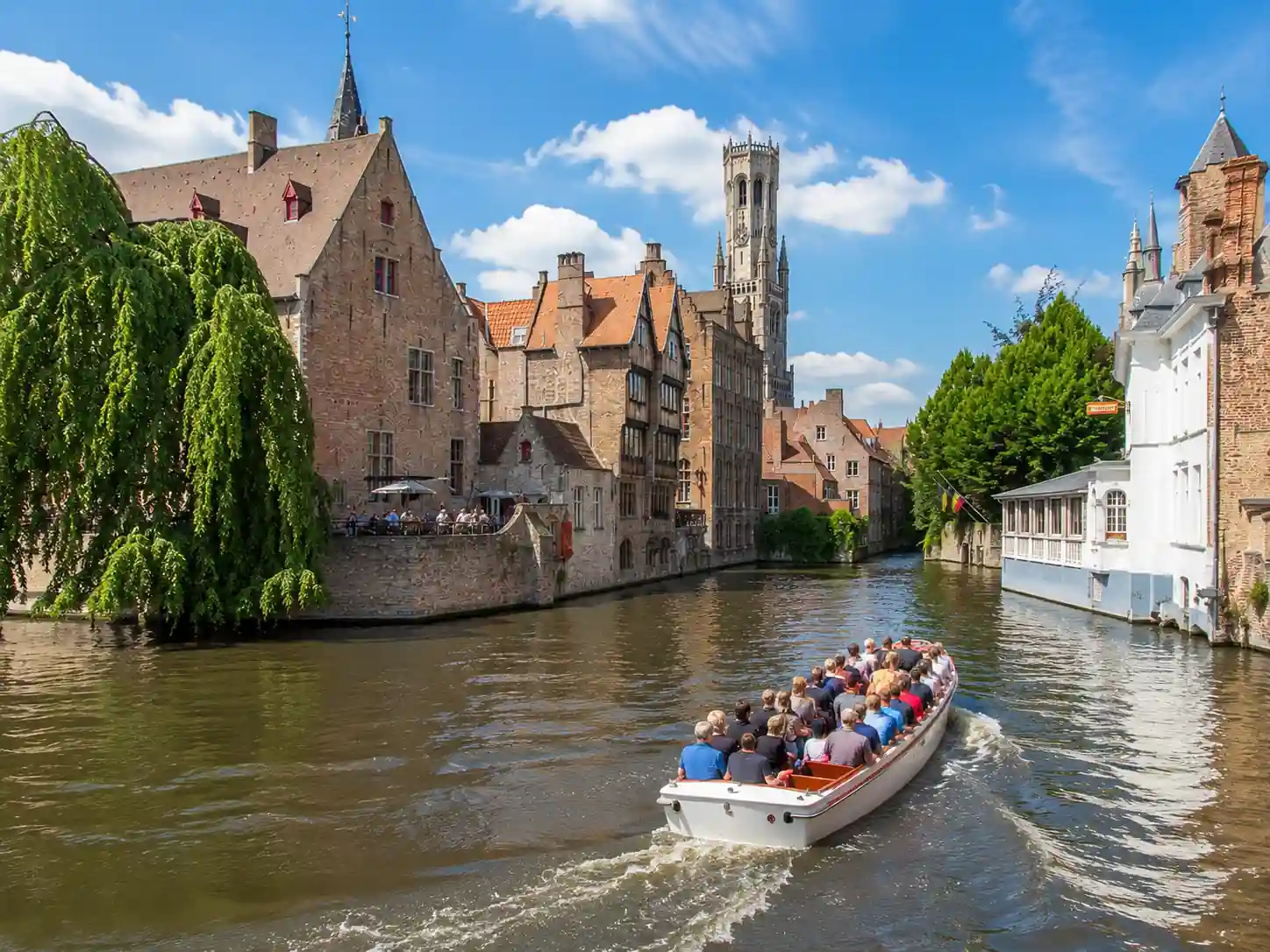
- Rozenhoedkaai - the most photographed canal view in Bruges, a five-minute walk from the Markt
- One major museum - the Groeningemuseum (Flemish Primitive paintings) or the Church of Our Lady (Michelangelo's Madonna), not both in depth
- A canal boat tour - 30 minutes, departs from Dijver and several other points, gives an excellent overview of the canal network
- Belgian food - waffles, fr ites, shrimp croquettes, and a Belgian beer at a brasserie terrace
- The main shopping streets - chocolate shops, lace shops, and the boutiques along Steenstraat
- The Belfry climb - 366 steps, 45 minutes minimum. With a full-day trip itinerary, this often has to be cut or rushed.
What a day trip cannot cover
- Multiple museums in depth - the Groeningemuseum alone warrants 90 minutes; adding Gruuthusemuseum, the Church of Our Lady museum, and the Memling Museum is simply not realistic in a single day
- Sint-Anna and the northern quarter - the residential area with windmills, the Jerusalem Chapel, and Café Vlissinghe is a different city from the tourist circuit, and day-trippers rarely reach it
- An unhurried dinner - day-trippers leaving by 6 or 7 pm miss the restaurant experience that defines Bruges for many overnight visitors
- The evening city - this is the significant omission, and the one that makes the overnight stay a categorically different experience
The day trip crowd reality
A significant practical consideration: Bruges receives the majority of its visitors as day-trippers. The crowd peak - 11 am to 4 pm - is entirely composed of people doing exactly what you are doing. This is when the Markt fills, the Belfry queue extends, and Rozenhoedkaai becomes an obstacle course of tripods. A day trip, by definition, places you inside this window for most of your time in the city. An overnight stay allows you to be there before and after it.
The Day Trip Itinerary: Making the Most of One Day
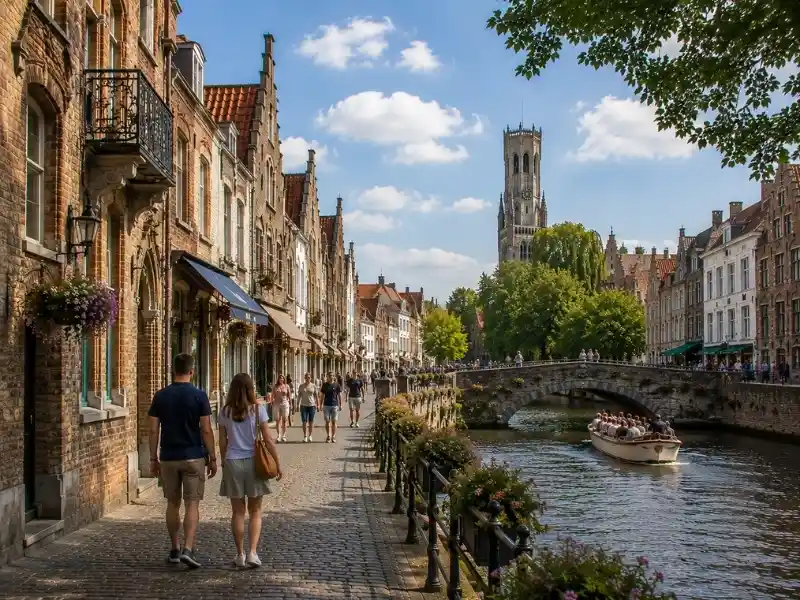
If a day trip is your only option, the sequence matters significantly. This itinerary is designed for a visitor arriving from Brussels by the 8:30 am train, arriving in Bruges around 9:30 am, and returning by the 6:30 or 7 pm train.9:30 AM - Arrive at Bruges station. Walk or bus to the Markt (20 min walk, or 10 min on bus line 1 or 2)
9:45 AM - Markt and breakfast at a canal-side brasserie while the square is still quiet
10:30 AM - Belfry of Bruges (opens 9:30 am, arrive as early as possible to beat queues; 366 steps, allow 45 min)
11:30 AM - Burg Square and Basilica of the Holy Blood (free entry, 20 min)
12:00 PM - Walk to Rozenhoedkaai and the canal district (15 min walk, take photographs)
12:30 PM - Canal boat tour from Dijver (30 min, runs continuously from 10 am–6 pm in season)
1:15 PM - Lunch near the canal, garnaalkroketten and a Belgian beer at a traditional brasserie
2:30 PM - Groeningemuseum (Flemish Primitive paintings, Jan van Eyck, Hans Memling, allow 90 min)
4:00 PM - O.L.V-kerk Museum (Museum Of The Church Of Our Lady)
5:00 PM - Chocolate and waffle stop on the return toward the station
6:00 PM - Walk or bus back to Bruges station
This is a full day, purposeful and well-structured, and it covers the genuine highlights. It does not cover everything. It misses Sint-Anna, the windmills, and the second layer of museums. It also misses everything that happens after 6 pm. For a first visit from Brussels, where Bruges is one stop on a longer trip, this is a reasonable day well spent.
What the Overnight Stay Adds
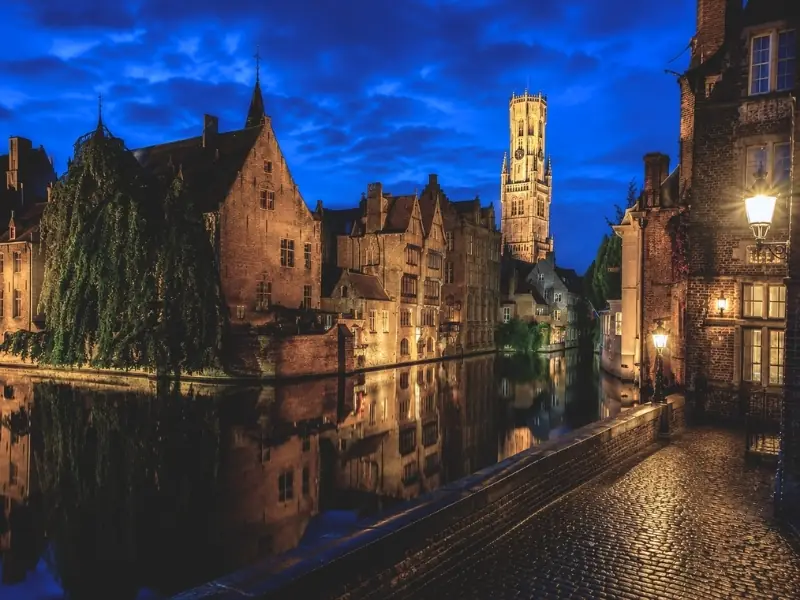
The overnight stay does not simply give you more time to see more things, though it does that too. It changes your relationship with the city in ways that are difficult to explain in practical terms but consistently described in the same emotional register by visitors who have experienced it.
The evening city
The transformation that happens in Bruges between 6 pm and 9 pm is one of the more striking things in European travel. By 6 pm, most day-trippers have caught their trains or coaches home. The Markt empties. The canal streets quiet. And what remains is the city that residents actually live in, lit differently, paced differently, and populated by people who are there because they choose to be rather than because their tour schedule says so.
At night, Bruges is wonderful, magical. The crowds disperse, and you are left in this beautifully lit, fairytale town. This is not travel writing hyperbole; it is the consistent experience reported by visitors across multiple platforms and decades of visitor feedback. The canal reflections at Rozenhoedkaai after 8 pm, the Belfry lit against a dark sky, the empty cobblestone lanes between the Markt and the Beguinage: these are genuinely different from the daytime versions of the same views, and they are only accessible if you stay.
The early morning city
Equally distinctive and equally inaccessible to day-trippers is Bruges before 9 am. The canal streets at 7 am in summer carry a different quality of light, a different silence, and a different atmosphere from anything available to visitors arriving on the 8:30 am train from Brussels. Rozenhoedkaai with no one else at the viewpoint. The Markt with delivery bikes and café staff setting up chairs. The Beguinage, with only the sound of the bells and the swans on the Minnewater.
Photographers who have visited Bruges at both times of day are unambiguous about which produces the better images. Couples who have done both a day trip and an overnight stay are equally clear about which they prefer.
More time, less pressure
With two days in Bruges rather than one, the itinerary pressure disappears. You no longer have to choose between the Groeningemuseum and the Church of Our Lady. You can climb the Belfry in the morning of day one and spend a relaxed afternoon in Sint-Anna on day two. You can have a proper dinner rather than a rushed lunch, try two or three Belgian beers with intention rather than in a hurry, and sit at a canal-side café for an hour without calculating whether you can afford the time.
Bruges is such a charming city that on a first visit of two nights, the expectation of moving on after one day dissolves, and the city holds you longer than anticipated. This is a common experience and a reliable one. Bruges is compact enough to survey in a day but rewarding enough to inhabit for two or three.
The Overnight Itinerary: Two Days in Bruges
For visitors staying one night and spending two days in Bruges, this sequence makes the most of both the early morning advantage and the evening access.
Day One
7:00 AM - Rozenhoedkaai and canal walk before the city wakes (empty, best light)
8:30 AM - Breakfast at a brasserie on the Markt (quiet, before day-trippers arrive)
9:30 AM - Belfry of Bruges at opening (shortest queue of the day)
11:00 AM - Basilica of the Holy Blood and Burg Square
12:00 PM - Groeningemuseum (90 min, while Markt crowds peak outside)
1:30 PM - Choco-Story Museum
3:00 PM - Canal boat tour from Dijver
4:00 PM - Bruges Beer Experience
6:00 PM - Beguinage and Minnewater Park
7:30 PM - Dinner at De Stove or Le Mystique (reservation essential)
Day Two
9:30 AM - Gruuthusemuseum (Gruuthuse Museum)
11:00 AM - Church of Our Lady (Michelangelo's Madonna and royal tombs)
12:30 PM - Lunch on a canal-side terrace near the Gruuthusemuseum
2:00 PM - Walking Guided Tour Bruges
4:00 PM - Chocolate shops on Steenstraat and Simon Stevinplein
5:00 PM - Return to station
Who Should Choose Each Option
| Your situation |
Best choice |
Why |
| Based in Brussels for a longer trip, Bruges is one stop among several |
Day trip |
Trains are frequent, the journey is 1 hour, and a well-structured day covers the highlights efficiently |
| First visit to Belgium, Bruges is the primary destination |
Overnight (1–2 nights) |
The evening city is a central part of the Bruges experience and is inaccessible on a day trip |
| Visiting in July or August |
Overnight |
Peak crowds are worst in the midday window an overnight stay gives you early morning and evening access when the city is at its best |
| A couple on a romantic weekend break |
Overnight (minimum) |
The evening Bruges canal walks, candlelit dinner, and empty streets is a romantic experience. A day trip misses it entirely |
| Travelling with young children, logistics-heavy |
Day trip or 1 night |
One full structured day covers the child-friendly highlights; an extra night adds flexibility without overextending |
| Interested in Flemish art and museum depth |
2 nights minimum |
The Groeningemuseum, Church of Our Lady museum, Gruuthusemuseum, and Memling Museum each warrant 60–90 minutes; fitting more than one into a day trip is not realistic |
| Travelling from Amsterdam or London |
Overnight |
Travel time from both cities reduces usable day-trip hours significantly; an overnight stay ensures the journey is worthwhile |
The Honest Verdict
A day trip to Bruges is not a mistake. It covers the primary sights, it delivers the essential atmosphere of the canal streets, and for visitors who are genuinely passing through Belgium with limited time, it is a worthwhile use of a day. If your alternative is not going at all, go for the day.
But if the question is whether the overnight stay adds enough to justify the cost and the extra night of accommodation, the answer is unambiguous: yes. The version of Bruges that exists before 9 am and after 7 pm is the version that most people find they remember longest. It is quieter, more atmospheric, and more personal than the daytime city. It is the version that makes visitors return.
Staying overnight gives you the advantage of seeing Bruges without the day trippers, and after 5 pm, when the crowds have left, Bruges is a completely different place. That difference is not marginal. It is the difference between visiting a beautiful city and actually experiencing one.
Whichever option you choose, the Bruges E-pass makes sightseeing significantly more efficient, covering free entry to the Belfry, the Groeningemuseum, the Church of Our Lady museum, and many other attractions in a single pass. For day-trippers managing a tight schedule, eliminating ticket queues at each attraction saves meaningful time. For overnight visitors, it makes exploring the second day completely hassle-free.