Best Photo Spots in Bruges: Iconic Views, Hidden Corners, Canals, and Night Scenes
Bruges is compact, walkable, and almost unreal on camera: medieval brick facades, swan-filled canals, stepped gables, stone bridges, and lantern-lit streets that look designed for photography. This guide brings together Bruges’ most rewarding photo locations both the famous postcard viewpoints and the quieter places that feel like discoveries plus practical timing, composition ideas, and on-the-ground tips.
Quick Plan for Photographers
If you want Bruges photos that look calm and cinematic (not packed with people), your biggest advantage is timing. The same places feel completely different at different hours.
- Best light: Sunrise for soft shadows and quiet canals; golden hour for warm brick tones; blue hour for reflections and glowing street lamps.
- Least crowded: Early mornings (before 09:00) and evenings after dinner.
- Best weather for photos: Light overcast for even lighting; calm wind for mirror reflections; winter mist for atmospheric canal scenes.
- Bring: A small tripod (or a steady mini-tripod), a wide lens (or phone 0.5x), a microfiber cloth (canals + drizzle), and a power bank.
Iconic Bruges Photo Spots
Rozenhoedkaai (Rosary Quay)
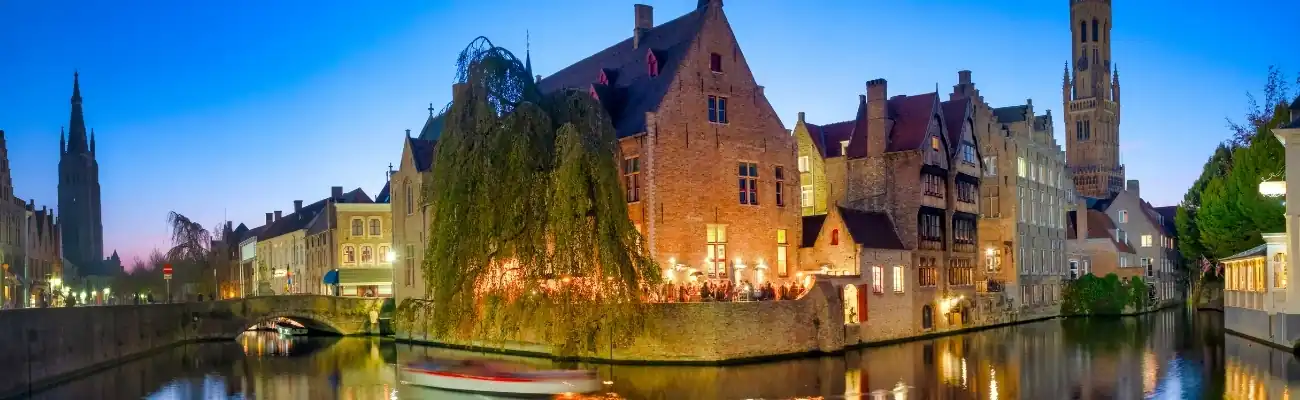
If you only have time for one viewpoint, make it Rozenhoedkaai. This is the classic Bruges composition: a gentle canal curve, medieval facades, and the Belfry rising in the distance. It’s postcard Bruges, but it still feels special in person especially when the canal is perfectly still.
- Best time: Sunrise for fewer people and softer tones; blue hour for glowing windows and reflections.
- Best shot: Wide angle with the canal as a leading curve; try a vertical frame to double the reflection.
- Pro tip: Stay 20–30 minutes after sunset. The sky deepens and the lights become the star of the scene.
Markt Square + Belfry (Belfort)
Bruges’ main square is a perfect stage: stepped-gable guild houses, cobblestones, and the Belfry dominating the skyline. It’s busy by day, but early morning and late night turn it into a calm, cinematic set.
- Best time: Early morning for clean compositions; night for an illuminated Belfry and empty cobblestones.
- Best shot: Centered symmetry facing the Belfry, or a diagonal composition including guild houses and café terraces.
- Pro tip: Use people sparingly for scale one cyclist crossing the frame can make the photo feel alive without feeling crowded.
Burg Square (City Hall + Basilica of the Holy Blood)
Burg Square is where Bruges shows off its architectural range: the Gothic City Hall, ornate facades, and the Basilica of the Holy Blood tucked into the corner. It photographs beautifully in low light, when the details pop under warm illumination.
- Best time: Early morning for quiet; evening for dramatic lighting.
- Best shot: A wide frame capturing multiple facades, or isolate City Hall details with a tighter crop.
- Pro tip: Look for framing opportunities at the edges of the square arches and corners create natural “frames.”
Church of Our Lady (Onze-Lieve-Vrouwekerk)
The Church of Our Lady is instantly recognizable by its tall brick tower. It’s a strong “vertical subject” in a city full of horizontal canal lines. It also sits close to some of Bruges’ best canal scenes, making it easy to combine architecture and reflections in one walk.
- Best time: Late afternoon for warm brick tones; blue hour for silhouette + reflections.
- Best shot: Include the spire above rooftops from a canal bridge; use the canal to lead the eye toward the tower.
Hidden Gems and Lesser-Known Photo Spots
Bonifacius Bridge (Bonifaciusbrug)
Small, romantic, and quietly famous among photographers. Bonifacius Bridge is one of those places that looks like it’s been there forever. The canal here feels intimate stone bridge, ivy, and gentle reflections, especially in the morning.
- Best time: Early morning (it gets crowded later because it’s tiny).
- Best shot: Shoot from the side to include the arch and canal; try a low angle to emphasize the stone texture.
- Pro tip: Use portrait mode (or shallow depth of field) to isolate the bridge against soft canal reflections.
Blinde-Ezelstraat (Blind Donkey Alley) Arch Frame
One of Bruges’ best “frame within a frame” compositions. The arch and lantern naturally lead your eye into the scene, creating a cinematic tunnel effect perfect for storytelling photos.
- Best time: Evening, when the lantern glow is visible.
- Best shot: Place the arch as a dark frame and expose for the brighter street beyond.
Jan van Eyckplein
Elegant, calmer, and full of character Jan van Eyckplein sits slightly away from the busiest loops. The square’s historic buildings and nearby canal reflections make it an underrated night photography spot.
- Best time: Blue hour and night for reflections and warm lamp light.
- Best shot: A long exposure with still water; include the statue for a strong foreground anchor.
Groenerei (Green Canal)
A quieter canal stretch where Bruges feels like a private garden. Trees, ivy, and peaceful water turn simple scenes into painterly images. It’s perfect when you want Bruges without the crowds.
- Best time: Midday on overcast days; golden hour for warm highlights on brick.
- Best shot: Capture the bridge reflection for a soft, symmetrical composition.
Nature, Canals, and Scenic Views
Minnewater (Lake of Love)
Minnewater is where Bruges slows down. The lake, the classic bridge, swans, and the surrounding park create romantic images in any season. It’s also one of the best places for soft reflections away from the busy center.
- Best time: Morning mist (if you’re lucky) and golden hour.
- Best shot: The bridge centered with swans as foreground elements; reflections in calm water.
- Pro tip: If it’s windy, wait a moment often the water calms in brief intervals.
Begijnhof (Beguinage)
Quiet, minimal, and extremely photogenic. The white houses and central green lawn create a calm visual rhythm. In spring, flowers can make it one of the most beautiful places in the city.
- Best time: Morning for peace and clean compositions.
- Best shot: Symmetry with repeating doors and windows; detail shots of textures and shutters.
Windmills on the Ramparts
For a different Bruges mood, head to the windmills along the old city ramparts. The open sky, grassy hills, and canals nearby create wide, airy compositions especially at sunset when the windmills become silhouettes.
- Best time: Sunset for dramatic skies and silhouettes.
- Best shot: Wide landscape with a windmill placed on the third; include the rampart path as a leading line.
Canal Bridges (Your Secret Weapon)
In Bruges, bridges are photography platforms. Each bridge changes the angle of the canal, the reflections, and the skyline. If you want variety, keep hopping from bridge to bridge and shoot both directions.
- Best time: Any, but sunrise and blue hour are the most rewarding.
- Best shot: Choose a canal curve and let it lead the eye toward a tower or gabled roofline.
Romantic and Night Photography Spots
Bruges is famous for its daytime charm, but the city becomes even more cinematic after sunset. Lights reflect in the canals, streets grow quiet, and the medieval facades glow warm against deep blue skies.
Rozenhoedkaai at Blue Hour
- Why it works: The reflections intensify when windows and street lamps light up.
- How to shoot: Use a tripod or stable surface; slow shutter for smooth water; keep ISO low for cleaner detail.
Markt Square at Night
- Why it works: The Belfry lighting turns the square into a dramatic scene.
- How to shoot: Symmetry shots look great here; long exposure can reduce moving people.
Jan van Eyckplein for Reflections
- Why it works: Calmer area, fewer crowds, strong reflections.
- How to shoot: Try long exposure and include the statue as a foreground anchor.
Burg Square After Dark
- Why it works: Architectural details stand out with warm lighting.
- How to shoot: Expose for highlights and lift shadows slightly later in editing.
A Walkable Bruges Photo Route (Half Day)
This route connects the most photogenic areas in a way that feels natural on foot. You can do it in 3–5 hours depending on how often you stop.
- Sunrise: Rozenhoedkaai
- Morning: Burg Square → Blinde-Ezelstraat arch
- Late morning: Canal walk toward Church of Our Lady → Bonifacius Bridge
- Midday calm: Begijnhof → Minnewater (Lake of Love)
- Afternoon option: Groenerei (Green Canal) or Jan van Eyckplein
- Blue hour / Night: Rozenhoedkaai → Markt Square → Burg Square
Practical Photography Tips for Bruges
- Go wide, then go tight: Take a wide establishing shot, then immediately capture details (lanterns, door knockers, canal reflections).
- Use reflections as your second subject: A “good” Bruges photo often has two layers of architecture above, reflection below.
- Watch for bikes: A single bike can add story; too many can clutter. Time your shot.
- Bring a cloth: Bruges can be drizzly. Keep your lens and phone camera clean.
- Respect quiet spaces: Begijnhof and churches are peaceful places. Keep photography discreet and respectful.