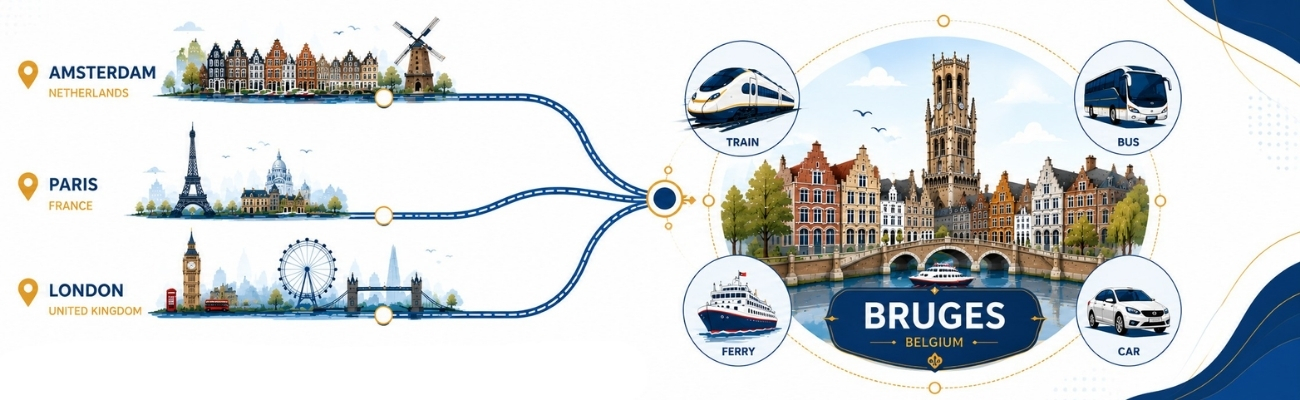
Bruges sits at a remarkable geographic sweet spot. It is two and a half hours from Paris by high-speed train, just under three hours from Amsterdam, and around three hours from London - including the Channel Tunnel crossing. For a medieval city of this scale and beauty, the accessibility is almost unreasonable. You can leave London at breakfast, arrive in Bruges before noon, spend a full day walking the canals and eating garnaalkroketten, and be back in time for a late dinner at home. Or, better still, stay the night.
This guide covers every realistic option for reaching Bruges from each of the three major gateway cities: train, bus, car, and, where relevant, ferry, with accurate travel times, current price ranges, booking tips, and a clear recommendation for each route. Prices and timetables change seasonally, so specific figures here reflect 2025 data and are best confirmed at the point of booking.
Getting to Bruges from Amsterdam
Amsterdam and Bruges are 250 kilometres apart by road and connected by one of the best-served international rail corridors in Europe. The two cities are different enough in character to justify combining them in a single trip. Amsterdam's canal ring and contemporary energy sit in interesting contrast to Bruges's preserved medieval atmosphere, and the journey between them is comfortable and efficient by train.
By Train - The Recommended Option
There is no single direct train from Amsterdam to Bruges, but the connection is straightforward. The fastest route operates via the high-speed Eurostar (formerly Thalys) from Amsterdam Centraal, changing at either Antwerp Central or Brussels-Midi for an onward Belgian Intercity service to Bruges. Total journey time: approximately 2 hours 59 minutes to 3 hours on the fastest services.
Experienced travellers particularly recommend the Antwerp connection. Changing at Antwerp Central rather than Brussels-Midi keeps the journey more direct, and Antwerp Central itself is one of the finest railway stations in Europe, worth arriving slightly early to appreciate. From Antwerp, a direct Belgian Intercity to Bruges runs hourly and takes around 1 hour and 30 minutes.
Tickets from Amsterdam to Bruges start from around €40 one way if booked well in advance through NS International or Eurostar.com. Leaving bookings to the last minute can push prices significantly higher, particularly on weekend departures. Booking several weeks or a few months in advance usually offers the best fares.
- Departs from: Amsterdam Centraal
- Arrives at: Brugge station
- Journey time: Approximately 2h 51m – 3h (fastest services)
- Change required: Yes, at Antwerp Central (recommended) or Brussels-Midi
- Price range: Train fares typically start from around €40 when booked well in advance.
- Frequency: Numerous daily connections
By Bus - The Budget Option
FlixBus operates a direct service from Amsterdam Sloterdijk station to Bruges, running five times daily. Journey time is approximately 4 hours 20 minutes. Tickets start from around €20–22 one way, making this the cheapest option on the route by a significant margin.
The trade-off is time and comfort: you gain roughly 80 minutes in travel time compared to the train, and the experience of a long coach journey versus a comfortable high-speed rail connection. For budget-conscious travellers with flexible schedules, the bus is entirely viable. Note that buses depart from Sloterdijk, not Amsterdam Centraal factor in travel time to reach the correct departure point.
At a glance:
- Departs from: Amsterdam Sloterdijk station
- Arrives at: Brugge station
- Journey time: Approximately 4h 20m
- Price range: From €20–40 one way
By Car
The drive from Amsterdam to Bruges covers around 240 kilometres via the A16 motorway, passing through or around Antwerp. Without traffic, the journey takes approximately 2 hours and 58 minutes, slightly faster than the train. However, the Antwerp ring road is one of the most congested stretches of motorway in Europe, particularly during weekday morning and evening peak hours, and realistic journey times in traffic can extend significantly. Parking in Bruges's historic centre is also restricted - the recommended option is the large parking garage at Bruges train station (€10–25 per day), from which the city centre is a 20-minute walk or a short bus ride.
Driving makes most sense for families with large amounts of luggage, or for visitors planning to explore the wider Flemish countryside beyond Bruges itself. For most travellers, the train is meaningfully more convenient.
Getting to Bruges from Paris
Paris to Bruges is the most seamlessly connected of the three routes in this guide. The journey combines the high-speed Eurostar (Thalys) network between Paris and Brussels with the efficient Belgian domestic rail service from Brussels to Bruges, and the fastest connections complete the trip in under two and a half hours.
By Train - The Recommended Option
Trains depart from Paris Gare du Nord, accessible by Métro lines 4 and 5 as well as RER B and D, and travel at high speed to Brussels-Midi in just 1 hour 22 minutes. From Brussels-Midi, Belgian Intercity trains depart frequently to Bruges, with the onward journey taking approximately 1 hour. Total door-to-door journey time on the fastest connections: around 2 hours 25–30 minutes.
There is no direct single-train service from Paris to Bruges, but the Brussels change is simple and well-signposted. At Brussels-Midi, follow signs for Belgian domestic trains and check departure boards for Bruges (Brugge). Belgian Intercity trains are unreserved - no seat booking required - and run multiple times per hour during the day.
Tickets for the Paris–Brussels Eurostar leg start from around €43–80 booked in advance, with the Brussels–Bruges Belgian Rail ticket adding a standard domestic fare on top. The Paris–Brussels Eurostar operates up to 30 trains per day, giving considerable flexibility for departure times. Tickets go on sale 12 months before travel, and advance booking consistently produces the best fares.
At a glance:
- Departs from: Paris Gare du Nord
- Arrives at: Brugge station
- Journey time: Approximately 2h 25m–2h 30m on fastest services
- Change required: Yes at Brussels-Midi (simple, well-signposted)
- Price range: From €43 for Paris–Brussels (Eurostar) + Belgian domestic ticket; higher on the day
- Frequency: Up to 30 Paris–Brussels services daily
By Bus
FlixBus and BlaBlaCar Bus both operate services from Paris Bercy-Seine Bus Station to Bruges, departing around three to four times daily. Journey time is approximately 4 hours and 50 minutes. Tickets start from around €24–50 one way.
The bus covers roughly the same price range as an advance Eurostar ticket once Belgian rail is factored in, but at double the travel time. It works best for travellers with very flexible schedules who are prioritising the lowest possible fare above all else.
By Car
Paris to Bruges by road is approximately 290 kilometres, taking around 3 hours under normal traffic conditions via the A1 autoroute through Lille. Toll charges apply on the French motorway network. As with the Amsterdam route, the Antwerp ring road can add significantly to journey times, and parking logistics in Bruges require planning. The train is faster, more convenient, and eliminates driving fatigue on a journey of this length.
Getting to Bruges from London
London to Bruges is the most involved of the three journeys in this guide, but it remains entirely manageable as a long day trip or a weekend break, and the Eurostar makes the Channel Tunnel crossing a non-event. Post-Brexit passport and border control procedures add time that did not previously apply, so planning around this is important.
By Train via Eurostar - The Recommended Option
Trains depart from London St Pancras International (served by multiple London Underground lines and domestic rail connections) and travel through the Channel Tunnel to Brussels-Midi in approximately 2 hours. From Brussels-Midi, Belgian Intercity trains run to Bruges in around 1 hour, giving a total journey time of approximately 3 to 3.5 hours.
Eurostar tickets for London to Brussels start from around €54–80 booked in advance, rising sharply for last-minute bookings.
Allow extra time for border procedures: Post-Brexit travel from the UK requires British exit border control and French/Belgian entry border control at St Pancras before departure. Eurostar recommends arriving at St Pancras at least 45 to 60 minutes before departure as a minimum, and during busy periods — particularly Fridays and Sunday afternoons — 90 minutes is more realistic. Do not underestimate this. Missing the Eurostar because of passport queue delays is the most common cause of disrupted London–Bruges itineraries.
At a glance:
- Departs from: London St Pancras International
- Arrives at: Brugge station (via Brussels-Midi change)
- Journey time: Approximately 3h–3h 30m total
- Change required: Yes, at Brussels-Midi
- Price range: From €54 (London–Brussels Eurostar) + Belgian domestic fare
- Frequency: Around 6 Eurostar departures per day from London to Brussels
- Arrive at St Pancras: At least 60 minutes before departure - 90 minutes on busy travel days
By Bus
FlixBus operates services from London Victoria Coach Station to Bruges via Dover, running approximately once daily. Journey time is around 6 to 7.5 hours, depending on ferry crossing times and traffic. Tickets start from around €23–40 one way.
The bus is a viable option for travellers on very tight budgets, but the time difference versus the Eurostar - roughly three to four additional hours each way- is substantial. On a short break, that difference in travel time meaningfully affects how much of Bruges you can actually see.
By Ferry
The Harwich to Hoek van Holland overnight ferry, operated by Stena Line, is worth considering for visitors from East Anglia or those who prefer to avoid the Channel Tunnel. Travelling overnight in a cabin, you arrive in the Netherlands and connect by train to Bruges via Antwerp. This is a slower but genuinely comfortable and atmospheric alternative - particularly for travellers who enjoy the crossing itself.
The Hull-Zeebrugge direct ferry, which formerly provided the most direct sea route to Bruges, has closed. There are currently no direct ferry services from the UK to Bruges or Zeebrugge.
By Car via the Channel Tunnel (Eurotunnel Le Shuttle)
Driving from London to Bruges via the Eurotunnel Le Shuttle at Folkestone takes approximately 3.5 to 4 hours under normal conditions, plus the 35-minute tunnel crossing. You load your car onto the train at Folkestone and drive off at Coquelles near Calais, then continue via the Belgian motorway network. One-way vehicle fares start from around £80–100 booked in advance.
The car route makes most sense for families travelling with significant luggage, or for visitors combining Bruges with other Belgian destinations on a self-drive itinerary. For a straightforward London–Bruges break, the Eurostar is faster, cheaper, and eliminates the complexity of parking.
Arriving in Bruges: Getting from the Station to the City Centre
All trains from Amsterdam, Paris, and London arrive at Brugge station, which sits on the southern edge of the historic centre. The walk from the station to the Markt (Market Square) takes approximately 18 to 20 minutes and is a genuinely pleasant route that passes several historic sights, making it a useful first orientation walk for new arrivals.
Alternatively, the Centrum Shuttle runs between Brugge station and the historic centre approximately every 20–25 minutes. Since 1 July 2025, the shuttle is no longer free for tourists; non-residents pay €3 per ride.
Left luggage lockers are available at Bruges station and are card-operated, which is useful if you want to drop bags before checking into accommodation.
Quick Comparison: All Three Routes at a Glance
- Amsterdam → Bruges: Train (~3h, from €40) or bus (~4h 20m, from €20) train recommended
- Paris → Bruges: Train (~2h 30m, from €43 + Belgian domestic) or bus (~4h 50m, from €24) train strongly recommended
- London → Bruges: Eurostar + Belgian Rail (~3h 15m, from €54 + domestic) or bus (~6h 30m, from €23) Eurostar recommended; allow 60–90 min at St Pancras
Booking Tips for All Routes
- Book early. Train tickets on all three routes are significantly cheaper when booked in advance, often 60 to 90 days ahead. Last-minute prices on the Eurostar routes in particular can be several times higher than advance fares.
- Travel on a weekday. Weekend fares on Belgian domestic rail are actually discounted, but Eurostar fares between major cities tend to be higher on Fridays and Sundays. Midweek departures often produce the best combinations of price and journey experience.
- Book through official operators. For the London and Amsterdam routes, booking directly on Eurostar.com offers the best access to promotional fares. Third-party booking platforms are useful for price comparison, but may not always have access to the cheapest advance fares.
- Consider the Bruges E-pass. Once you arrive, the Bruges E-pass gives you free entry to the Belfry, major museums, and many of the city's top attractions, making it the most efficient way to organise your time once you get there.
Final Thoughts
Bruges is one of the most accessible heritage destinations in Europe, and that accessibility is a genuine part of what makes it worth visiting. The combination of a compact, walkable historic centre and short, direct rail connections from three of the continent's largest cities means that getting there is not an obstacle, it is simply the beginning of the visit. Book your train early, allow sufficient time at St Pancras if travelling from London, and arrive knowing that the canals, the beer, and the cobblestones are considerably closer than they might seem on a map.