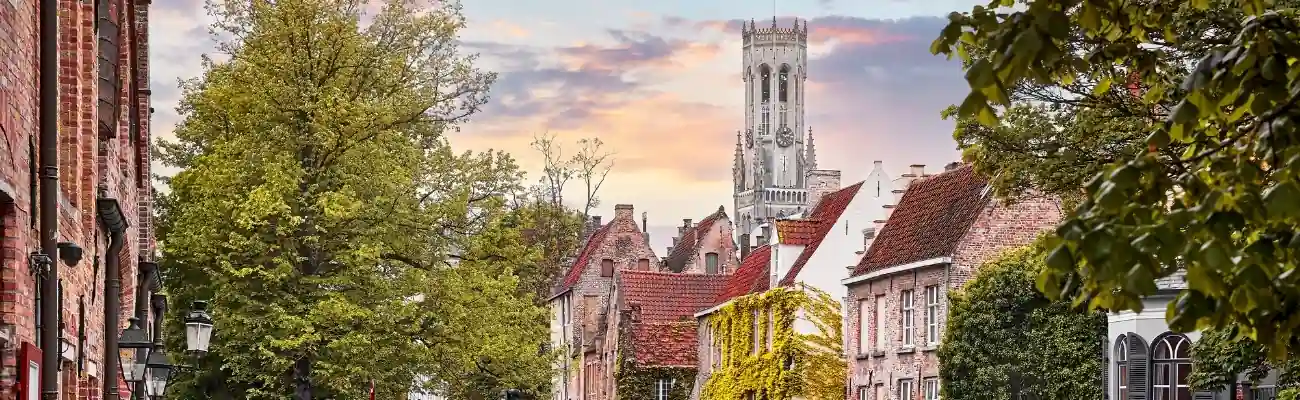
The Belfry of Bruges has been watching over the city since the 13th century. It has survived three fires, a lightning strike, the French Revolution, two world wars, and eight centuries of Flemish weather. At 83 metres tall, it leans 87 centimetres to the east, a tilt so gradual it is invisible from the ground, and its 47-bell carillon plays across the rooftops on Wednesday, Saturday, and Sunday mornings as it has done for hundreds of years. It is, without question, the most recognisable structure in Bruges.
It is also, for many visitors, the most daunting. Three hundred and sixty-six steps. No lift. A staircase that narrows as you climb. Bells that ring every fifteen minutes with a volume that is, to put it gently, significant. Standing at the base of the tower looking up, the question is not whether the view from the top is worth it; it is, but whether you know what you are actually committing to when you buy the ticket.
This guide answers that question honestly and in detail. What the climb actually feels like. What you will see on the way up. What the view looks like from the top. When to go for the best experience. And what to know before you set off.
The Belfry of Bruges: A Brief History
The Belfry was added to the Markt around 1240, when Bruges was one of the wealthiest trading cities in northern Europe, a centre of the Flemish cloth industry with commercial connections stretching to England, Italy, and the Baltic. Like belfries across the Low Countries, it served a practical civic function: a watchtower from which the city could monitor for fires and incoming threats, a repository for the city's most important documents and funds, and a bell tower whose different bells communicated different messages to the population below. Danger, celebration, the time of day, the opening and closing of markets, all were announced from this tower.
A devastating fire in 1280 destroyed the upper half of the tower. The city archives, irreplaceable, were lost to the flames. The tower was rebuilt, and the octagonal upper stage that gives the Belfry its distinctive crowned silhouette was added between 1483 and 1487. A wooden spire bearing an image of Saint Michael was installed at the summit, only to be destroyed by a lightning strike in 1493. Another wooden spire replaced it and survived for two and a half centuries before fire claimed it too in 1741.
The tower as it stands today, topped by the octagonal stone lantern rather than a spire, is the result of these cumulative rebuildings. Since 1999, it has been recognised as a UNESCO World Heritage Site as part of the Belfries of Belgium and France serial property.
Before You Go: What You Need to Know
A few practical facts that make a meaningful difference to how you experience the climb.
- The entrance is not on the Markt. The ticket office is accessed through the archway at the back of the Belfry, which leads into the inner courtyard of the former Cloth Hall. From the Markt, walk through the archway to the left of the tower facade and follow the signs. The first few steps from the ground to the ticket office already count toward the 366 total — so by the time you have your ticket scanned, you have already started.
- Bags must be stored before you climb. Free lockers are available near the entrance. The staircase is too narrow to accommodate backpacks, and you will be asked to leave them. Bring only what fits in a coat pocket or small cross-body bag.
- You have a 45-minute window from entry. Once your ticket is scanned, you have 45 minutes to complete the visit. In practice, this is generous; most visitors take 30 to 40 minutes, but it is worth being aware of, particularly if you plan to linger at the top.
- Numbers are strictly limited. The staircase is narrow, and two-way traffic becomes genuinely difficult near the top. Musea Brugge manages visitor numbers carefully. This means queues can form at peak times, and the climb is manageable and unhurried once you are inside. Book your time slot online to avoid waiting.
- There is no lift. The Belfry is not wheelchair accessible, and the climb requires reasonable physical fitness. There are rest stops on each floor, and the ascent is self-paced, but 366 steps is 366 steps. Visitors with heart or respiratory conditions should consider carefully before committing.
The Climb: Floor by Floor
The Belfry is not simply a staircase with a view at the top. There are six distinct stops on the way up, each with its own character and content. Here is exactly what you encounter at each level.
The Entrance Hall
Before the climb begins, the entrance hall at ground level contains information panels about the history and functioning of the Belfry, including the carillon mechanism and the tower's role in medieval civic life. It is worth spending five minutes here; the context makes the rooms above considerably more interesting. A scale model of the tower structure shows the relationship between the different floors.
The staircase begins with stone steps. They are wide enough at this stage to pass other visitors comfortably, and the spiral is gradual. The rope handrail that runs along the outer wall of the staircase is there for support and is worth using consistently.
The Treasury Room
The first stop is the Treasury Room, the medieval strongroom where the city's charters, official seals, and public funds were stored behind heavy iron doors. The iron-reinforced doors are still in place, and the room gives an immediate sense of how seriously medieval Bruges took its commercial and civic records. The loss of the city archives in the fire of 1280, documents that would have been irreplaceable records of one of northern Europe's most important trading centres, is made tangible by standing in the room that was built specifically to prevent exactly that kind of loss from happening again.
Rest here if you need to. There are benches. The climb to this point is not particularly demanding, but the Treasury is the last room with genuinely generous space before the staircase begins to narrow.
The Great Bell Room
From the Treasury, it is approximately 108 steps, without a stop, to the Great Bell Room. This is where the physical effort of the climb begins to register. The staircase is still stone at this point, but has narrowed, and the spiral has tightened. Take your time. There is no pressure to rush.
The Great Bell Room houses Bella Maria, the largest of the Belfry's bells, transferred here from the Church of Our Lady in 1800. Bella Maria weighs six tonnes and has a diameter of more than two metres. Seeing it in the context of the tower, not in a museum display but hanging in the position it was built to occupy, in the room designed around it, is a different experience from any reproduction or photograph. The bell rings on the hour, and if the timing works in your favour, you will hear it from here. Bring earplugs if you have them, or be prepared to cover your ears: at this range, the sound is genuinely physical.
The Drum Room
Another 112 steps from the Great Bell Room brings you to the Drum Room, the mechanical heart of the carillon. The drum is a large rotating cylinder studded with metal pins, programmed to trigger specific bells at specific intervals. Think of it as a mechanical music box at civic scale. The programming of the drum, which determines what the carillon plays, is changed only every two years, a process that requires physically repositioning each pin on the cylinder. The complexity of this mechanism, and the fact that it has been operating in some form in this tower for centuries, is one of the more quietly extraordinary details of the visit.
By this point in the climb, the staircase has become noticeably narrower. Passing other visitors on the way down requires patience and, occasionally, creative use of available space. The rope handrail is increasingly useful. Take your time. The steps are still manageable, but they demand attention.
The Carillonneur's Room
Nineteen steps above the Drum Room is the Carillonneur's Room, a small space containing the keyboard from which the city carillonneur plays the bells live on Wednesday, Saturday, and Sunday mornings from 11 am to noon. On other days, the room is empty, but the keyboard, a system of wooden levers and pedals connected by wires to the 47 bells above, is visible through the door. If you arrive during a live performance, you may briefly see or hear the carillonneur at work. The keyboard looks nothing like a conventional piano; it is a physical instrument that requires fist and foot technique rather than finger pressure.
The staircase from here to the top is the most challenging section of the climb. The steps become wooden rather than stone, the spiral tightens significantly, and two-way passing becomes genuinely difficult. The last thirty or so steps before the viewing platform are narrow enough that visitors heading down must wait for those heading up before proceeding. This is managed without difficulty; everyone is in the same situation, but if you have any claustrophobic tendencies, this is the section to be aware of.
The Top: The Viewing Platform
The viewing platform at the top of the Belfry is enclosed by stone walls with open windows, covered by wire mesh, which affects photography but does not significantly impede the view. The panorama is 360 degrees and, on a clear day, reaches the sea.
What strikes most visitors immediately is the scale of it. Bruges from street level feels like a city of narrow lanes and intimate canal views. From 83 metres above the Markt, the city reveals its full plan: the canal network radiating outward from the centre, the three towers, the Belfry, the Church of Our Lady, and Sint-Salvatorskathedraal marking the skyline in a triangle, the medieval city walls and windmills visible at the edges, and the flat green Flemish countryside stretching to the horizon in every direction. On clear days, the North Sea coast is visible to the northwest, and Zeebrugge's harbour can be distinguished roughly twelve kilometres away.
The bells ring every fifteen minutes. The sound at the top of the tower, directly beneath the 47-bell carillon, is loud enough to feel as much as hear. First-time visitors are sometimes startled. If you have any sensitivity to loud noise or suffer from tinnitus, bring earplugs or time your visit to avoid the quarter-hour marks.
The descent is where many visitors discover that going down a narrow spiral staircase after a significant physical effort is its own challenge. The wooden steps in the upper section require attention, and the knees register the 366 steps more on the way down than on the way up. Take your time, use the handrail, and let gravity do a moderate amount of the work.
When to Go
The best time to climb the Belfry is at opening, 9:30 am on most days, or in the late afternoon from 4:30 pm onwards. Both slots avoid the heaviest queue periods, which concentrate between 11 am and 3 pm. Morning visits offer soft directional light over the canal network from the top and the clearest air. Late afternoon visits offer warmer golden light and often empty streets visible below as day-trippers begin leaving.
If you want to hear the carillon live, visit on a Wednesday, Saturday, or Sunday between 11 am and noon. These are also the busiest times, so factor in additional queue time and book your slot online in advance.
Summer season hours run from 9 am to 8 pm. Winter hours run Sunday to Friday, 10 am to 6 pm, and Saturday, 9 am to 8 pm. The Belfry closes in severe weather and on Christmas Day and New Year's Day.
Practical Information
- Address: Markt 7, 8000 Bruges · Click here to see the location
- Entrance: Through the archway at the back of the tower into the inner courtyard, not directly from the Markt
- Opening hours (summer): Daily 9:00 AM – 8:00 PM
- Opening hours (winter): Sunday–Friday 10:00 AM – 6:00 PM; Saturday 9:00 AM – 8:00 PM
- Admission: €6 per adult (2026 price) · Children under 5 free
- Bruges E-pass: The Belfry is included with the Bruges E-pass. You can make your reservation and get your QR code easily.
- Booking: Online booking is strongly recommended to secure your time slot, especially in July and August.
- Time to allow: 45 minutes inside the tower; additional time for queuing if you have not booked online
- Not accessible: No lift, no wheelchair access
- Bags: Free lockers are available at the entrance; backpacks must be stored before climbing
Is It Worth It?
The honest answer: yes, if the conditions are right for you. The view from the top is genuinely exceptional, one of the finest panoramas available from any medieval tower in northern Europe, and one that reveals Bruges in a way that street-level sightseeing simply cannot. The floors on the way up add genuine historical interest rather than functioning as mere rest stops. And the physical effort, while real, is manageable for most reasonably fit adults and older children.
If you have mobility limitations, severe claustrophobia, or a significant sensitivity to loud noise, the Belfry is honestly not the right experience. If you are fit, the weather is clear, and you book an early morning or late afternoon slot, it is one of the most memorable hours available in Bruges.
With the Bruges E-pass, entry is free and included, removing the ticket queue from the equation entirely and saving the €16 adult admission toward other experiences in the city.
Final Thoughts
The Belfry has been the defining feature of Bruges's skyline for eight hundred years. It has communicated fire alarms, market hours, and celebrations to the people of this city across more generations than most of us can meaningfully imagine. Standing at the top and looking out over the canal network and the red rooftops and the flat Flemish plain beyond, it is easy to understand why the people of medieval Bruges invested so heavily in building something this ambitious in the centre of their market square. They wanted to be seen. They wanted to be heard. They wanted something that would last.