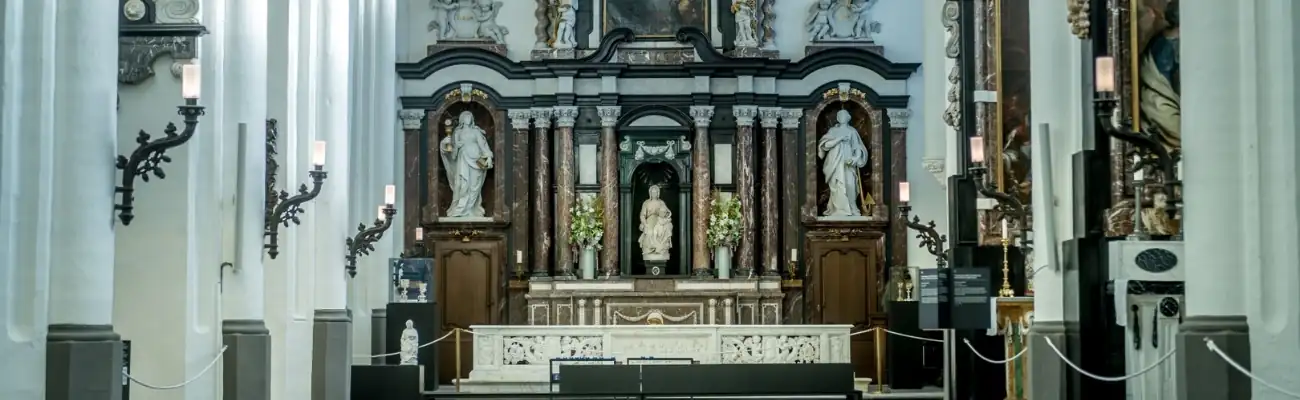
There is a moment that catches most visitors off guard. You have walked through the doors of the Church of Our Lady, adjusted to the light, let the sheer verticality of the Gothic nave register, and then you see it. In a side chapel to the right of the choir screen, behind a protective glass panel, stands a white marble figure barely larger than a toddler. A seated woman. A child at her knee, about to step away. The room around it is quiet in the way that rooms around extraordinary things tend to be quiet. This is Michelangelo's Madonna and Child, the only sculpture by Michelangelo to leave Italy during his lifetime, and it has been standing in this church in Bruges for over five hundred years.
The Church of Our Lady (Onze-Lieve-Vrouwekerk in Flemish) is one of the most significant religious and artistic sites in Belgium, and one of the most underappreciated by visitors who treat it as an afterthought between the Belfry and the canal boats. This guide covers everything worth knowing before you go: the history of the church, the sculpture itself, the other treasures inside, the royal tombs, practical information on opening hours and admission, and what to look for when you stand in front of the Madonna.
The Church: A Brief History
The site on which the Church of Our Lady stands has been a place of worship for over a thousand years. A small wooden church stood here in the second half of the 9th century, serving as one of the earliest places of Christian worship in what would become Bruges. That modest building grew in prestige over the following centuries until a fire in 1116 effectively ended that chapter. The same year, Our Lady became an independent parish, and the foundations for a more ambitious structure were laid.
Construction of the present Gothic building began between 1210 and 1230 and continued across several centuries, as was typical of large medieval churches. The result is a layered structure that carries the architectural language of different periods, completed with the addition of the Paradise Portal in the 15th century. The church's tower at 115.5 metres, the third-highest brick tower in the world, was added progressively and remains one of the defining elements of the Bruges skyline, visible from the canal network and from the top of the Belfry alike.
The church has survived a great deal. It came through the Iconoclasm of the 16th century, when religious images across the Low Countries were systematically destroyed, largely intact. It was sold publicly during the French Revolution. And twice, once under Napoleon, once under the Nazis during the Second World War, its greatest treasure, the Michelangelo Madonna, was seized and carried away. Each time, it came back.
Michelangelo's Madonna and Child: How It Arrived in Bruges
The story of how a Michelangelo came to be in a side chapel in a small medieval city in Belgium is one of the more improbable episodes in art history, and it begins with cloth.
Jan and Alexander Mouscron were brothers from a wealthy Bruges family engaged in the international trade of English woollen cloth. Their commercial networks stretched across Europe, with offices in Florence and Rome, where they traded with Italian suppliers and where, around 1501 to 1504, they came into contact with a young Florentine sculptor of rapidly growing reputation. Michelangelo had recently completed his Pietà in Rome and was at work on the David in Florence. The Mouscron brothers acquired the Madonna and Child sometime around 1504 to 1506, paying 100 ducats for the piece, and arranged for it to be shipped to Bruges.
Michelangelo's handling of the transaction was characteristically secretive. He instructed his associates in Florence to guard the marble figure carefully and hide it from visitors. The young Raphael, then in Florence, was specifically mentioned as someone who should not be allowed to see it. Michelangelo did not want to be copied, and particularly did not want a work leaving Italy to be seen before it had left. In the event, Raphael appears to have caught a glimpse anyway: art historians have identified the influence of the Bruges Madonna's composition in at least two of Raphael's subsequent Madonna and Child works.
Whether the statue was intended for the Piccolomini altar in Siena Cathedral, or was always destined for Bruges, remains a matter of scholarly debate. What is certain is that once it arrived in the Church of Our Lady, it became one of the first works by Michelangelo to be widely seen outside Italy and one of the first to influence Northern European artists who had not made the journey to Florence or Rome.
Albrecht Dürer, the great German Renaissance artist, recorded seeing it during his visit to the Netherlands on 7 April 1521. He described it as a beautiful Madonna, a remarkable understatement for what is now recognised as one of the defining sculptures of the High Renaissance.
What Makes the Madonna Exceptional: Reading the Sculpture
Standing in front of the Bruges Madonna for the first time, what strikes most visitors is how different it is from what they might expect of a devotional sculpture of this period. Traditional representations of the Madonna and Child tended toward sweetness: a smiling Virgin gazing tenderly at an infant held comfortably in her arms. Michelangelo's version is something altogether more unsettling and more modern.
Mary sits in a frontal, composed posture, her face long, her expression not warm but remote, her gaze directed downward and slightly away from her son. She does not look at him. Her left hand rests loosely around the Christ Child, not clasping or restraining, but barely touching. The child, meanwhile, is not lying in her lap in the conventional pose. He stands upright, almost unsupported, his body caught in the moment of stepping away from his mother and down into the world. He is held back only by that light touch of her hand.
Art historians have read this composition as a meditation on the Incarnation and its implications. Mary already knows, as she must, what her son's life will mean, and her expression is not happiness but a stoic, sorrowful acceptance. The child moves toward his destiny, and she lets him go. The sculpture is 128 centimetres tall, carved from a single block of Carrara marble, and it displays the High Renaissance pyramid composition also associated with Leonardo da Vinci, whose influence Michelangelo both drew on and resisted.
The similarities with the Vatican Pietà, completed shortly before, are deliberate: the flowing robes, the movement of the drapery, the long oval face of the Virgin. But where the Pietà shows the Christ in death, the Bruges Madonna shows him at the threshold of life and the emotional logic of the two works is designed to mirror each other.
The Statue's Turbulent History
The Madonna and Child has been stolen twice in its history, on both occasions by conquering military forces.
The first theft occurred during the French Revolutionary period, when Napoleon's forces systematically looted Belgium's finest art and shipped it to Paris. The Madonna, along with major works by Van Eyck and Memling, was among the pieces taken. It was returned to Bruges after Napoleon's defeat and exile.
The second and more dramatic theft occurred in September 1944. As Allied forces advanced toward Bruges, the retreating German army removed the Madonna from the church and transported it eastward. It was eventually found by American forces members of the Monuments Men unit, whose mission was to locate and recover art stolen by the Nazis in an Austrian salt mine, the Altaussee salt mines in Styria, where the Nazis had concealed a vast collection of looted European art. The Madonna was returned to Bruges in 1945, miraculously undamaged.
Today, the statue stands behind protective glass, a measure put in place following the 1972 attack on Michelangelo's Pietà in Rome, when a vandal struck the Vatican sculpture with a hammer. The glass is not ideal for the viewing experience: it catches light in certain conditions and prevents close inspection of the marble's surface texture. Visiting in the morning, when the chapel light is softer, gives the clearest view.
What Else Is Inside the Church
The Royal Tombs of Charles the Bold and Mary of Burgundy
The church's chancel houses two of the most important medieval funerary monuments in Belgium: the gilded copper tomb effigies of Charles the Bold, the last powerful Duke of Burgundy, and his daughter Mary of Burgundy. Charles died at the Battle of Nancy in 1477; Mary, who inherited the Burgundian territories and through her marriage to Maximilian of Austria brought the Low Countries into Habsburg rule, died in a riding accident in 1482, aged just 25.
The tombs themselves, the figures rendered in gilded copper lying on black stone bases, their faces serene, armoured and crowned, are masterworks of late medieval craftsmanship. Mary of Burgundy's tomb is particularly fine: her effigy is widely considered one of the most beautiful examples of Flemish memorial sculpture. At her feet, a small dog. At Charles's feet, the heraldic lion of Burgundy.
The remains of Mary of Burgundy are buried within the church. Charles the Bold's body, initially buried at Nancy after his death in battle, was brought to Bruges in 1550 on the orders of his grandson, Emperor Charles V. Beneath the tombs, excavations in the 19th century revealed funerary urns containing the remains of both. These urns and the associated archaeological finds are on display in the museum section.
The Painting Collection
The church contains a significant collection of paintings, the most notable of which is the triptych of the Passion by Bernard van Orley, court painter to Margaret of Austria, displayed in the chancel. Works by Pieter Pourbus, including his Adoration of the Shepherds, and a Crucifixion by Anthony van Dyck, are also present, representing a range of Flemish painting from the 15th to the 17th century.
The 13th-century painted sepulchres, medieval tomb paintings preserved in the lower levels of the church, are among the oldest surviving polychrome decorations of their kind in Flanders and are visible in the museum section of the visit.
The Architecture
The church's interior is worth slow attention even for visitors primarily drawn by the Madonna. The Gothic nave, rebuilt and restored several times across its history, is now restored to its original condition after recent restorations and shows the clean vertical lines and window arrangements characteristic of Flemish Gothic buildings. The choir screen, the carved stone partition separating the nave from the chancel, is particularly fine, and the view from the nave upward through the screen to the high altar gives the best sense of the building's proportional ambition.
Practical Information
- Address: Mariastraat 38, 8000 Bruges · Click here to see the location
- Opening hours: Tuesday to Saturday 9:30 AM – 5:00 PM; Sunday 1:30 PM – 5:00 PM
- Admission: Entry to the main nave is free. The museum section, which includes Michelangelo's Madonna and Child, the royal tombs, and the painting collection, requires a paid ticket
- Ticket prices: Adults €10 / Under 6 free
- Bruges E-pass: The Church of Our Lady museum is included in the Bruges E-pass.
- Photography: Permitted in the main nave without flash. Not permitted in the museum section
- How long to allow: 10 to 15 minutes for the free nave and Madonna chapel; 60 to 90 minutes if including the full museum section
How to Get There
The Church of Our Lady sits on Mariastraat in the southern part of Bruges's historic centre, immediately south of the Gruuthusemuseum and a short walk from the Beguinage. From the Markt, the walk takes approximately 10 to 12 minutes on foot. From the Belfry, it is a 5-minute walk south along Gruuthuse Square and Mariastraat.
Practical Tips for Your Visit
- Visit in the morning for the best view of the Madonna. The chapel that houses the sculpture receives its clearest light in the morning, and the glass panel causes the least reflection before noon. Afternoon sun from certain angles catches the glass and obscures the view.
- Check for closures. The church may have partial closures during religious services.
- Combine with the Gruuthusemuseum. The Gruuthusemuseum's private chapel overlooks the church interior through a small window, one of the more unusual viewing angles available in Bruges. Both attractions are managed by Musea Brugge and are included in the Bruges E-pass.
- Photography in the museum section is not permitted. The free nave allows photographs; the museum section does not. Plan accordingly.
- The best angle for the Madonna. Art historians note that the statue was probably designed to be viewed from slightly below and to the right, as it would have been if displayed high above an altar. In its current position, viewed face-on at close range, Mary's face can appear slightly fuller than intended. Try stepping to the right of the sculpture and looking up slightly for the angle closer to what Michelangelo envisioned.
Final Thoughts
The Church of Our Lady is one of those attractions that takes longer to appreciate than it takes to visit. The Madonna requires no specialist knowledge to affect you; it does its work without explanation. But understanding why it is here, how it came to Bruges, how many times it has been taken and returned, and what Michelangelo was trying to express in the moment of the child stepping away from his mother, all of this makes the sculpture considerably more resonant than it would be encountered without context.
Set aside at least 90 minutes if you plan to visit the full museum section. Arrive in the morning. Stand in front of the Madonna for longer than feels comfortable. Then step to one side, look at it from a slight angle and from slightly below. That is when the expression on Mary's face shifts, and when the stoic sadness that Michelangelo built into the marble reveals itself most fully.