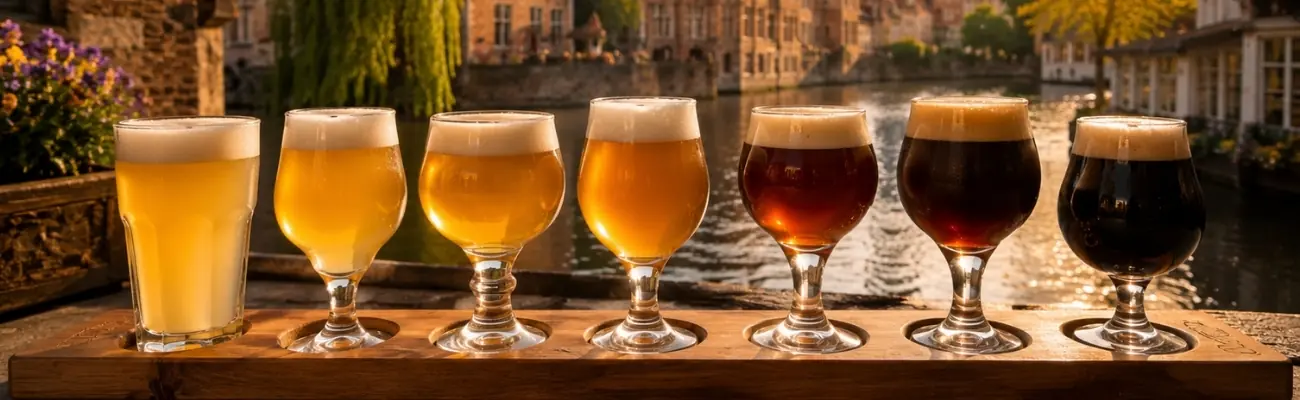
Standing in front of a Belgian beer menu for the first time can feel quietly overwhelming. Not because the menu is confusing, but because it is the wrong kind of long. Thirty, forty, sixty beers, many with names you have never seen before, alcohol percentages that seem improbably high for something being served in a café, and a row of completely different glasses behind the bar, each apparently reserved for a specific brew. The server is perfectly friendly. The menu is printed beautifully. And you have absolutely no idea what to order.
This guide is written for exactly that moment. It covers the Belgian beer styles you are most likely to encounter in Bruges what they are, what they taste like, what alcohol level to expect, and what makes each one worth trying followed by the glassware rules that Belgians take seriously, the etiquette that separates a confident order from an obvious tourist one, and a suggested sequence for working through the styles if you have several evenings in the city to do it properly.
Why Belgian Beer Is Different
Belgium has around 300 active breweries producing over 1,500 distinct registered beer styles, figures that dwarf the output of most countries with far larger populations. But the number is less important than the diversity. Unlike German brewing, which operates within a strict tradition of four permitted ingredients (the Reinheitsgebot), Belgian brewing has always allowed and encouraged the use of additional ingredients: spices, herbs, fruit, wild yeasts, candi sugar, coriander, orange peel. The result is a range of beers that vary in colour from almost white to nearly black, in strength from 3 percent to 14 percent, in flavour from bracingly sour to intensely sweet, and in texture from light and effervescent to thick enough to coat the glass.
Belgian beer culture was granted UNESCO Intangible Cultural Heritage status in 2016, recognising not just the brewing techniques but the entire cultural practice surrounding it: the glassware, the serving rituals, the food pairings, the café culture that has built up around specific beers over centuries.
The Main Belgian Beer Styles: A Beginner's Map
Witbier (White Beer)
Start here if you are not a regular beer drinker, or if you want something light before moving on to stronger styles. Witbier is a wheat beer, hazy, pale yellow to milky white, lightly fruited with spices such as coriander and dried orange peel, and gently refreshing with moderate carbonation. Alcohol content is typically 4.5 to 5.5 percent. The style was almost extinct in the 1960s before Pierre Celis revived it with Hoegaarden, which remains the most internationally famous example. In Bruges, Blanche de Bruges from De Halve Maan is the local witbier and a good starting point.
What it tastes like: Lightly spiced citrus, wheat, gentle banana. Low bitterness. Easy and refreshing.
ABV range: 4.5–5.5%
Glass: Round, wide-mouthed tumbler or hexagonal glass
Drink it when: First beer of the day, warm weather, with seafood or a light lunch
Belgian Blonde Ale
The Belgian blonde is the style most likely to deceive a visitor who assumes something golden-coloured and malt-scented must be gentle. It is approachable and aromatic, with malty sweetness upfront, fruity yeast character, and some floral or spicy notes, but the alcohol level is typically 6 to 8 percent, significantly higher than a pale lager or a witbier. Duvel is the most celebrated example: a strong golden ale at 8.5 percent that drinks with a deceptive lightness that has caught out more than a few visitors who ordered a second before finishing their first. In Bruges, Brugse Zot Blond from De Halve Maan is the local answer and an excellent introduction.
What it tastes like: Malty, fruity, slightly sweet, lightly bitter finish. Golden colour, large white head.
ABV range: 6–8.5%
Glass: Tulip glass or branded chalice
Drink it when: Aperitif, with chicken or mild cheese, as a second beer after witbier
Dubbel
The dubbel is one of the great Trappist and abbey beer styles: dark amber to brown, malt-forward, and complex in a way that takes a few sips to fully register. The flavour profile revolves around dark fruit (raisins, plums, dates), caramel, toasted bread, and light chocolate, with a drying finish that prevents the sweetness from becoming cloying. The style was effectively codified at the Westmalle Trappist brewery, whose Westmalle Dubbel remains the benchmark still widely considered the finest expression of the style. Chimay Red (Chimay Première) is perhaps the most internationally available example. Alcohol content runs from 6 to 8 percent.
What it tastes like: Dark fruit, caramel, toasted malt, gentle spice. Rich but not heavy.
ABV range: 6–8%
Glass: Chalice or goblet
Drink it when: Evening, with braised beef, carbonade flamande, aged cheese or chocolate
Tripel
The tripel is the beer that surprises most beginners, and the surprise is always the same: it looks gentle and golden, it smells of fruit and spice, and then it delivers 8 to 10 percent alcohol in a package that goes down far more easily than it should. The style uses lighter malts than the dubbel, giving a pale golden colour, but adds candi sugar to drive the alcohol up while keeping the body light. The yeast provides complex aromatics: pear, banana, honey, white pepper, and the finish is characteristically dry. Westmalle Tripel is the original and remains the standard reference. La Trappe Tripel, Chimay White (Tripel), and locally in Bruges, Straffe Hendrik from De Halve Maan, are all accessible examples.
What it tastes like: Fruity (pear, banana), spicy (white pepper), dry finish. Deceptively light-bodied for its strength.
ABV range: 8–10%
Glass: Chalice or tulip glass
Drink it when: Evening meal, with roast pork, spicy dishes, shellfish, or strong cheese. Pace yourself.
Quadrupel (Quad)
The quadrupel is the most intense of the monastic beer styles, deep brown to almost black, with alcohol content typically running from 10 to 14 percent, and a flavour profile that combines everything the dubbel does with more of it: darker fruit, richer caramel, more pronounced warmth, and a complexity that develops in the glass over time. This is a sipping beer, drunk slowly and in small measures. Westvleteren 12, brewed at the Sint-Sixtusabdij monastery and famously difficult to obtain (the monastery sells it only at the abbey gate and does not export through conventional channels), is widely considered one of the finest beers in the world. Rochefort 10 is more accessible and almost as celebrated.
What it tastes like: Dark fruit, molasses, caramel, warmth. Complex and intense.
ABV range: 10–14%
Glass: Small chalice or snifter
Drink it when: After dinner. Treat it like a digestif, not a session beer.
Saison (Farmhouse Ale)
The saison originated as a practical solution to a seasonal problem: Belgian farmworkers needed a beer that could be brewed in winter, stored safely through the summer heat without refrigeration, and drunk by workers in the fields without making them incapable of working. The result was a beer brewed for drinkability, typically pale golden to amber, highly carbonated, with a dry and slightly tart finish driven by a distinctive fruity and peppery yeast character. Modern saisons range from 4.5 to 8 percent, and the style has been adopted enthusiastically by craft brewers worldwide. Saison Dupont from Brasserie Dupont is the classic example.
What it tastes like: Pepper, light citrus, hay, earthy yeast. Crisp and dry.
ABV range: 5–8%
Glass: Tulip or goblet
Drink it when: Warm weather, with salads, goat cheese, light pasta or grilled fish
Lambic, Gueuze, and Kriek
Lambic is unlike any other beer in the world, not because of its ingredients, but because of how it ferments. Rather than adding a cultivated yeast strain, the brewer leaves the hot wort exposed overnight in a shallow vessel called a coolship, allowing wild yeasts and bacteria present in the air of the specific geographic area around Brussels and the Pajottenland to inoculate the brew spontaneously. The resulting beer is sour, complex, and funky with notes of green apple, leather, barnyard, and citrus and takes between one and three years to mature fully in oak barrels.
Gueuze is a blend of young and aged lambics, re-fermented in the bottle for natural carbonation. It is sometimes called Brussels Champagne, and the comparison is apt: it is sparkling, dry, complex, and acidic, with fine persistent bubbles. Kriek is a lambic fermented with sour cherries, intensely tart and fruity, not sweet. Framboise (raspberry) is a similar style.
Lambic and gueuze are an acquired taste for some visitors. The sourness catches people off guard on a first sip. The advice that works consistently: treat it like sparkling wine, not beer. Chill it properly, pour carefully to preserve the head, and pair it with something salty or fatty. It will make sense quickly.
What it tastes like: Tart, sour, earthy, complex. Gueuze adds fine carbonation and sharpness.
ABV range: 4.5–6% typically
Glass: Fluted tulip or champagne flute
Drink it when: With seafood, mussels, salty frites, cheese, or fruit-based desserts
Belgian Beer Glassware: Why It Matters
The question visitors most often ask about Belgian glassware is whether the different glasses are really necessary or simply marketing. The answer is both, but with an important qualification: the glass genuinely affects what you taste, not just how the beer looks.
The shape of a glass determines how much surface area contacts the air (affecting carbonation release and aroma), how the foam (head) develops and holds, and what temperature the beer reaches at the point of your lips. A wide-mouthed chalice concentrates the aroma of a dubbel or tripel. A narrow flute preserves the fine carbonation of a gueuze and delivers it cold. A round hexagonal tumbler for witbier ensures you can swirl the sediment to distribute the yeast, which carries flavour, before each sip.
In Belgian cafés, it is entirely normal for a bartender to delay serving your beer if the correct glass is not immediately available, or to ask if you would like a different beer rather than serve the one you ordered in a substitute glass. This is not pedantry; it is the same logic that leads a sommelier to use different wine glasses for different styles.
| Style |
Glass |
Why |
| Witbier |
Hexagonal tumbler or round tumbler |
Wide mouth allows swirling of yeast sediment; maintains cold temperature |
| Blonde / Tripel / Dubbel |
Chalice or goblet |
Wide bowl concentrates complex aromatics; supports thick foam head |
| Strong golden (Duvel) |
Branded tulip glass |
Tulip shape builds foam head and channels carbonation; each brand has its own |
| Saison |
Tulip or goblet |
Supports carbonation and concentrates pepper and fruit aromatics |
| Lambic / Gueuze |
Fluted tulip or champagne flute |
Narrow flute preserves fine carbonation and delivers the beer cold |
| Quadrupel |
Small chalice or snifter |
Smaller volume appropriate for high ABV; wide mouth releases warmth and aroma |
Belgian Beer Etiquette: Drinking Like a Local
Belgian beer etiquette is less about rules and more about habits that signal genuine engagement with the culture rather than treating it as a novelty. Here is what actually matters in practice:
Let the bartender choose the glass. Never ask for a different glass than the one the bartender provides. The glass is part of the beer's identity, and requesting a pint glass for a Trappist ale or a standard mug for a gueuze is the surest way to mark yourself out as someone who does not understand what they are drinking.
Drink at the right temperature. Belgian beer is not served ice cold. Different styles have specific serving temperatures: witbier and lambic are served quite cold, strong ales are served cool, and some aged quadrupels are best approached closer to cellar temperature. If you refrigerate a Belgian tripel and drink it straight from the cold, you will miss most of what makes it interesting. Trust the temperature it arrives at.
Pour correctly. When pouring bottled beer, tilt the glass and pour slowly down the side until two-thirds full, then raise the bottle and pour directly down the centre to build the head. Many Belgian beers have sediment at the bottom of the bottle; leave the last centimetre in the bottle unless you specifically want the yeast character, in which case swirl the bottle gently and pour it in.
Respect the strength. Many Belgian beers run from 8 to 14 percent ABV, roughly twice the strength of a standard lager. A tripel at 9 percent is not a session beer. Two or three over an evening is a full evening of drinking. Belgian locals tend to drink fewer beers but with more attention to each one. This is not asceticism; it is what the beers are actually designed for.
Pair with food. Belgians treat beer with food in the same way the French approach wine with intention and pairing logic rather than arbitrary choice. Malty dubbels pair naturally with red meat and stews. Crisp saisons work with lighter dishes and salads. Sour lambics cut through rich cheese and fatty foods. Strong golden ales match with cream sauces and shellfish. When in doubt, ask the bartender. Belgian café staff typically know their beer lists in depth.
Do not rush. The cardinal rule. Belgian beer culture values slow, attentive drinking over quantity. If you are working through a beer list at a traditional brasserie in Bruges, take one beer properly: note the colour, the head, the aroma before drinking, the way the flavour develops over several sips, before ordering the next. The beers reward attention in a way that rewards the attention back.
A Beginner's Tasting Order
If you have several evenings in Bruges and want to work through the main styles in a sensible sequence, the following order moves from lightest to most complex and gives each style the best chance of landing properly:
- Witbier — light, refreshing, low ABV. Sets the palate.
- Belgian Blonde — malt and fruit character at moderate strength. A reference point for yeast-driven Belgian flavour.
- Saison — dry, peppery, effervescent. Shows what Belgian yeast can do differently.
- Dubbel — dark fruit, caramel, complexity. First encounter with monastic brewing character.
- Tripel — golden and strong, deceptively easy. The style that most surprises first-timers.
- Gueuze — sour, complex, unlike anything else. Leave this until you are ready for it; it repays a palate that has warmed up.
- Quadrupel — slowly and in small measure, after dinner. A full stop on the evening.
You do not need to do all seven in a single session. Spread them over two or three evenings. In Bruges, the Bruges Beer Experience on Breidelstraat provides context for the history and brewing culture behind these styles, and De Halve Maan brewery on Walplein offers guided tours with tastings of the city's own Brugse Zot and Straffe Hendrik. Both are excellent starting points for making the styles feel less abstract before you encounter them at the bar.
For free entry to the Bruges Beer Experience alongside many of the city's other top attractions, the Bruges E-pass covers admission and saves the ticket queue a useful starting point for the beer education that the rest of your evenings in the city's brasseries will build on.