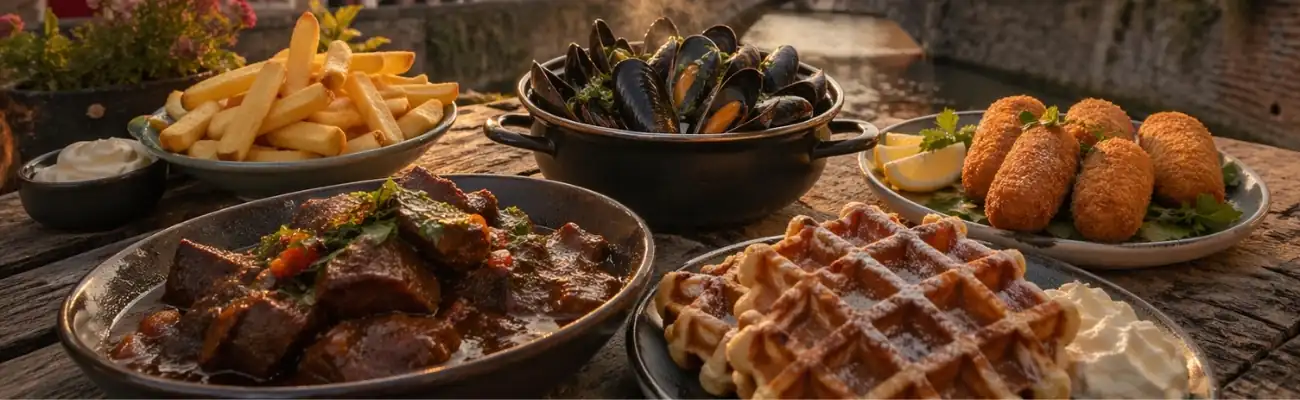
Belgian cuisine rarely announces itself loudly. It does not come with a theatrical presentation or complicated menus written in three languages. What it does, consistently and with remarkable confidence, is deliver comfort. The food of Bruges and the surrounding Flanders region is built on patience, long-braised stews, freshly fried croquettes, mussels cooked to order in white wine and cream, and on ingredients sourced close to the water, the farmland, and the coast. It is food that makes sense on a cold canal-side afternoon, food that pairs naturally with a dark abbey beer, food that rewards the visitor who sits down and orders properly rather than grabbing the first waffle they see.
This guide covers the dishes you genuinely should not leave Bruges without trying: what they are, why they matter, what makes the Belgian version distinctive, and where to eat them. From the slow-braised depth of carbonade flamande to the quiet debate between two very different waffles, this is everything you need to eat well in Bruges.
1. Flemish Beef Stew / Stoofvlees
If there is a single dish that defines the Flemish kitchen, it is carbonade flamande, known locally as stoofvlees. This is beef, slow-braised in Belgian dark beer until the sauce becomes thick, dark, and deeply flavoured, with caramelized onions, a slice of mustard-spread bread dissolved into the broth, and occasionally a piece of speculoos biscuit to balance the bitterness of the ale.
The result is something close to the best version of a beef stew you have ever eaten, but with a specific flavour profile that no other country's version quite replicates. French beef bourguignon uses wine. Belgian carbonade uses beer, typically an Oud Bruin, a Flemish Red, or a dark abbey ale, and the difference is fundamental. The beer brings a bitterness and complexity that wine does not, and the mustard adds a sharpness that cuts through the richness. Slow-cooked for several hours, the beef becomes so tender it gives with almost no pressure from a fork.
Carbonade flamande originated in Flemish peasant cooking as a practical way to make tougher cuts of beef palatable through long, slow cooking. Today, it appears on the menus of traditional Bruges brasseries as one of the most consistently ordered dishes by locals and visitors alike. It is almost always served with Belgian frites and mayonnaise, and occasionally with stoemp, a mash of potatoes with carrots, leeks, or cabbage, which is equally worth ordering.
What to look for when ordering:
- The sauce should be thick and glossy, not watery; a thin sauce means the stew has not cooked long enough.
- A mustard-spread bread slice dissolved into the sauce is traditional and a sign of an authentic preparation.
- Pair it with the same dark beer used in the cooking for the best flavour combination.
Where to eat:
- Restaurant Diligence— Hoogstraat 5 · Click here to see the location
TripAdvisor: 4.3/5 (902+ reviews) · An authentic, cozy restaurant in Bruges, located in the heart of the city. - De Gastro — Braambergstraat 6 · Google Maps
TripAdvisor: 4.6/5 (2,545+ reviews) · A family-owned spot near the Markt offering a Flemish tasting menu with carbonnade as the centrepiece.
2. Shrimp Croquettes / Garnaalkroketten
The shrimp croquette is one of Belgium's most distinctive dishes, surprising many visitors who expect the country's cuisine to be defined only by beer and chocolate. At their best, these are extraordinary things: a golden, crisp breadcrumb shell that gives way to a dense, creamy béchamel filling packed with tiny North Sea grey shrimp, finished with a squeeze of lemon and accompanied by deep-fried parsley.
The key ingredient is the grey shrimp, crevettes grises in French, garnalen in Dutch, small, intensely flavoured crustaceans caught in the North Sea and traditionally hand-peeled along the Belgian coast. Grey shrimp have a stronger, sweeter, and more complex flavour than the larger, blander varieties found elsewhere, and the Belgian croquette is built entirely around this quality. An authentic garnaalkroket should contain at least 30 percent shrimp; anything less and the flavour thins noticeably.
The shrimp croquette form was popularised in the mid-20th century and has since become one of the most beloved starters in the Belgian repertoire. In Bruges, close enough to the North Sea coast to benefit from fresh supply, garnaalkroketten appear on virtually every traditional brasserie menu and are worth ordering as a first course before a main of Flemish stew or mussels.
What to look for when ordering:
- A good croquette should be very hot throughout and crisp on all sides; a soggy coating indicates it has been sitting or reheated poorly.
- The filling should be dense and creamy, with a strong shrimp flavour dominant throughout.
- Squeeze the lemon and eat the fried parsley; both are functional, not merely decorative.
Where to eat:
- ‘t Werftje — Omookaai 8 · Click here to see the location
TripAdvisor: 3.9/5 (694+ reviews)
- Poules Moules — Simon Stevinplein 9 · Click here to see the location
TripAdvisor: 4.1/5 (2,258+ reviews) · Well-made croquettes alongside the full mussel menu. Outdoor terrace on a pleasant square.
3. Mussels and Frites / Mosselen met Friet
Belgium is widely credited with being the first country to serve mussels alongside frites, and the combination has long since become inseparable from the country's culinary identity. In Bruges, a city close to the North Sea and surrounded by the flat Flemish landscape that produces some of Belgium's finest potatoes, moules-frites is a natural and frequent order.
The most prized Belgian mussels come from Zeeland in the Netherlands, large, meaty, and full-flavoured. Mussel season runs from late summer through early spring, with September and October generally considered peak months. Outside of season, most restaurants use farm-raised Zeeland mussels year-round, which maintain consistent quality. In Bruges, mussels are served in large cooking pots; a portion is generous, alongside a basket of frites and Belgian mayonnaise.
Preparation styles vary and are worth knowing. Marinière (white wine, shallots, parsley) is the most classic. À la crème adds richness. Some Bruges restaurants offer a version cooked with a local Belgian beer, such as Straffe Hendrik or Brugse Zot; the malty broth becomes excellent for dipping frites into.
The frites themselves deserve separate attention. Made from high-starch bintje potato varieties and typically fried twice, once to cook through, once at high heat to crisp the exterior, Belgian frites are a dish in their own right. Served with Belgian mayonnaise rather than ketchup, they are significantly better than what most visitors expect.
What to look for when ordering:
- Any mussels that have not opened after cooking should be left uneaten.
- Use an empty shell as tongs to pick the remaining mussels, the accepted Belgian method.
- The cooking broth is worth drinking directly or soaking up with bread; it carries the full flavour of the preparation.
Where to eat:
- Breydel-De Coninck — Breidelstraat 24 · Click here to see the location
TripAdvisor: 4.0/5 (1,290+ reviews) · Historic address for mussels and frites, nine preparation styles on the menu.
- Brasserie Cambrinus - Philipstockstraat 19 · Click here to see the location
TripAdvisor: 4.3/5 (5,756+ reviews)
4. Brussels Waffle vs Liège Waffle
Belgium has two distinct waffle traditions, and knowing the difference before you reach a street stall or café will improve the experience considerably. Both are Belgian, both are sold across Bruges, and both are delicious, but they are made differently, taste differently, and suit different occasions.
The Brussels Waffle
Large, rectangular, with defined, even edges and deep square pockets. Made from a light, yeast-leavened batter incorporating beaten egg whites, it is airy, crisp when fresh, and has a texture that is simultaneously light and satisfying. The Brussels waffle is a dessert waffle served at a table with toppings such as whipped cream, fresh strawberries, chocolate sauce, or powdered sugar. It is eaten with a fork and a knife. It softens quickly once topped, so eat it immediately. This is the style that was introduced to American audiences at the 1964 New York World's Fair and became the model for what much of the world calls the "Belgian waffle."
The Liège Waffle
Smaller, oval, with irregular edges and a dense, chewy texture. Made from a thick dough, more bread-like than batter, enriched with butter and studded with chunks of pearl sugar. When cooked, the pearl sugar melts and caramelizes against the iron's surface, creating a sticky, sweet, slightly crunchy exterior. The result is rich and intensely flavoured from the caramelized sugar alone — no toppings are needed, and in Belgium, locals rarely add them.
According to Belgian culinary tradition, the Liège waffle was invented in the 18th century by the cook to the Prince-Bishop of Liège, who requested something sweet and portable. It is handheld street food eaten warm from a paper bag while walking, requiring nothing additional. Unlike the Brussels waffle, it does not soften as it cools and can be enjoyed hot, warm, or cold.
In Bruges, both types are widely available. Street stalls near the Markt and Steenstraat sell Liège waffles almost constantly. The smell of caramelizing pearl sugar is one of the most distinctive sensory memories of the city.
The simple rule:
- Walking around the city? Order a Liège waffle from a street stall. Eat it plain and warm.
- Sitting down at a café? Order a Brussels waffle with your choice of toppings. Eat immediately.
- Avoid heavily topped waffles from tourist-facing stalls near major landmarks, as toppings often mask average waffle quality.
Where to eat:
- Chez Albert — Breidelstraat 16 · Click here to see the location
TripAdvisor: 4.6/5 (1,746+ reviews) · The most consistently praised waffle address in Bruges. Known especially for Liège waffles eaten plain.
- House of Waffles — Wollestraat 32 · Click here to see the location
TripAdvisor: 4.6/5 (1,151+ reviews) Well-reviewed for sit-down Brussels waffles with a full range of toppings.
5. Waterzooi
Waterzooi is one of Belgium's most comforting and underappreciated dishes and one that many visitors overlook in favour of more famous options. The name translates approximately as "watery mess" in Flemish, which is not the most enticing description, but the dish itself is a generous, creamy stew that rewards anyone willing to order something slightly unfamiliar.
Waterzooi originated in Ghent, where it was traditionally made with fresh fish and seafood from the River Leie. As the river became less viable for fishing, the recipe adapted to chicken, now the more common version. In Bruges, you will typically find both: chicken waterzooi (kippen waterzooi) is richer and more accessible, while fish waterzooi is lighter and more delicate.
The broth is built from leeks, carrots, celeriac, and potatoes, simmered in stock and finished with cream and egg yolks. The result is thick, pale, and deeply savoury, somewhere between a soup and a stew, and always served with plenty of crusty bread to soak up the broth, which is arguably the best part of the bowl. It is a winter dish at heart, ideal after a long morning exploring the city in cold or rainy weather.
Where to eat:
- De Stove - Kleine Sint-Amandsstraat 4 · Click here to see the location
TripAdvisor: 4.6/5 (939+ reviews, #31 of 703 restaurants in Bruges) · Small, intimate, seasonal Flemish menu. Reservation essential, very few covers.
6. Belgian Frites and the Frituur
Belgian frites deserve their own mention beyond simply a side dish. A visit to a traditional frituur, a fries stand, is a cultural experience as much as a culinary one. Belgian frites are double-cooked to produce an exterior that is genuinely crisp and an interior that is floury and soft. Served in a paper cone with a selection of sauces — Belgian mayonnaise, andalouse, samurai they represent one of the world's great street foods without any fanfare.
Look for a frituur that fries fresh rather than from frozen. A queue outside is generally a reliable indicator of quality.
Where to eat:
- FritBar - Katelijnestraat 3 · Click here to see the location
TripAdvisor: 4.2/5 (320+ reviews) on Langestraat is a local recommendation for hand-cut frites with proper Belgian mayonnaise.
A Note on Belgian Chocolate and Speculoos
Bruges has more chocolate shops per square kilometre than almost anywhere else in Europe. The finest pralines, produced by chocolatiers such as Dumon (Eiermarkt 6), The Chocolate Line (Simon Stevinplein 19), and Del Rey (Breidelstraat 3), use a shell of tempered chocolate surrounding a ganache or nut filling and bear no resemblance to mass-produced supermarket chocolate. Buy a small box and eat slowly.
Speculoos, the spiced biscuit flavoured with cinnamon, nutmeg, ginger, and clove, is worth picking up from a bakery. You will also find speculoos used as an ingredient in desserts, waffles, and occasionally dissolved into carbonade flamande sauce to add a subtle background sweetness.
Final Thoughts
The best approach to eating in Bruges is straightforward: sit down, order a starter and a main, take your time, and pair everything with a Belgian beer that suits the dish. The most consistent kitchens in Bruges tend to operate on slightly quieter streets where the clientele includes a meaningful proportion of locals. A restaurant where a table of Bruges residents is eating carbonade flamande on a Tuesday lunch is a restaurant worth following.
Belgian food is not complicated, but it is deeply considered. Every dish on this list has a history, a logic, and a specific combination of ingredients and techniques that make it worth eating properly rather than in a hurry. Give it that time, and Bruges will feed you better than almost anywhere else in Europe.